

Song (1928)
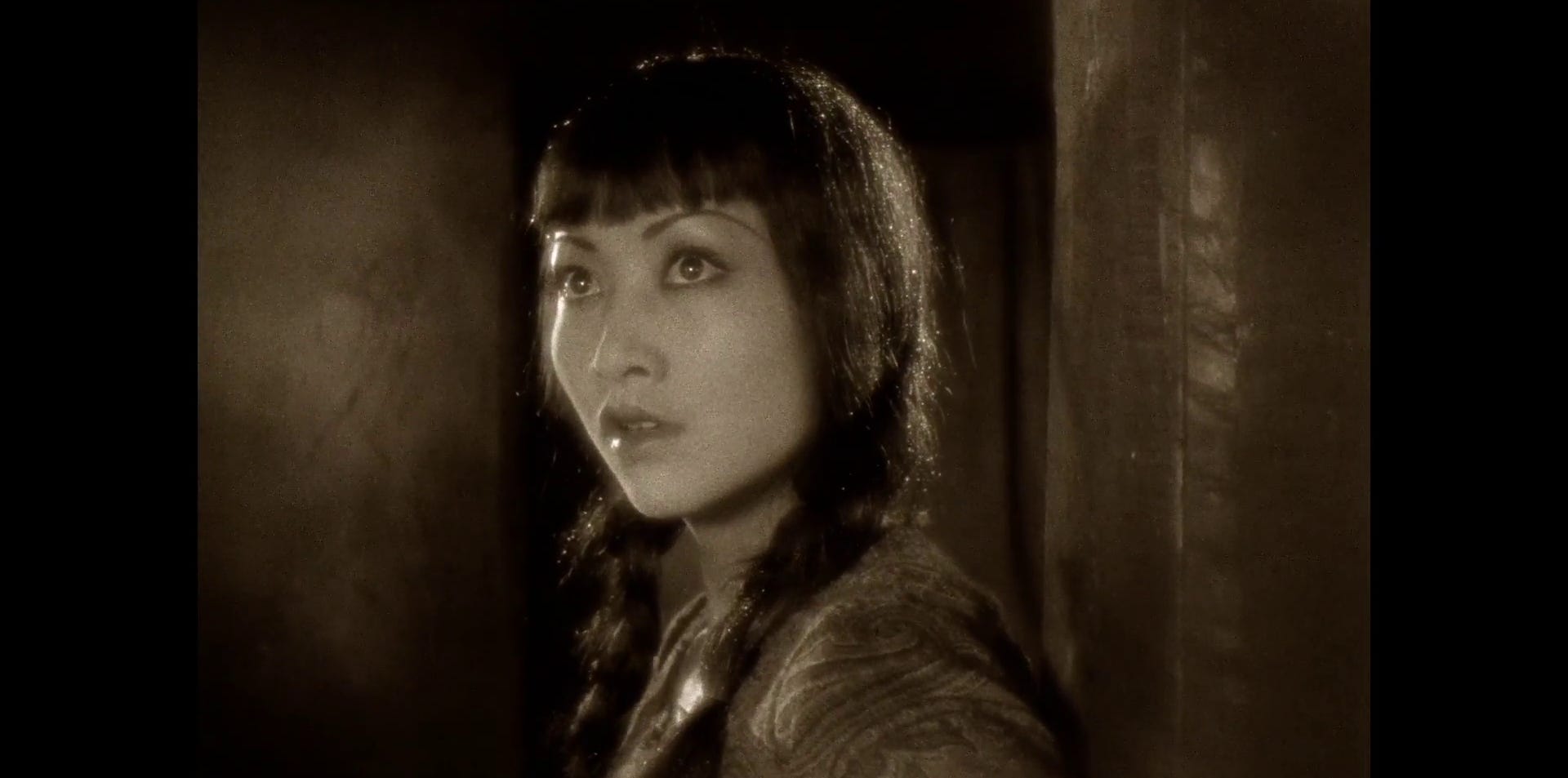
Anna May Wong stars in Richard Eichberg's tragic love-triangle melodrama, screening tonight at the BFI Southbank from a new restoration.

By Ellen Cleary
In an entertainment industry invested in Orientalist fantasies and marked by routine yellowface, Chinese American actress Anna May Wong forged a trailblazing career in the early 20th century to become an icon of the silver screen. Film professor Yiman Wang argues that, within the context of the profound white supremacism and specific anti-Asian discrimination in the U.S. – epitomised by the Chinese Exclusion Act (1882—1943) – Wong’s stardom encapsulates the tension of being at once “excluded and idolized”. Yet, what is also foregrounded in the BFI’s current Anna May Wong programme is the self-determined “Art of Reinvention” evident in her career: a resilience and versatility that took her “from silent cinema to multiple-language talkies, vaudeville to television, and Hollywood to Europe and beyond”.
Filmed in Babelsberg-dressed-as-Istanbul, star-maker director Richard Eichberg’s drama Song (1928) was Wong’s first European picture. Once a nickelodeon-obsessed kid who spent her time hanging around the movie lots near her Los Angeles neighbourhood, the film was a decisive step forward. After her first break as an uncredited extra in The Red Lantern (1919) and a much-praised leading turn in The Toll of the Sea (1922), Hollywood confined her to minor, stereotyped parts. A near-constant feature of such roles was the death scene, with her characters doomed by the requirements of American anti-miscegenation laws and the necessity to foreclose the disruptive potential of her exoticised sexuality. “I left America because I died so often,” Wong later recalled. “I was killed in virtually every picture I appeared in.” Europe would offer greater opportunities, but no complete break with the prejudices of the era.
While the subtitle of Song: The Love of a Poor Human Child speaks to a continuation of this racialised tragedy-as-spectacle, the film offered Wong more than previous marginalised roles, such as the opium dealer’s wife in Dinty (1920) or a “Mongol slave” in The Thief of Bagdad (1924). The starring role had been written especially with her in mind, giving Wong the opportunity she needed to demonstrate her abundant talent and magnetism. We first meet our titular protagonist in a moment of crisis: impoverished and alone, Song is harassed by two young men on a secluded beach before being rescued by John Houben (Heinrich George), a gruff knife-thrower tormented by his past. His protection soon proves perilous: once he takes her home, he begins using her as a prop for target practice, taking an almost sadistic pleasure in her terror. With few other options for subsistence, and grateful to her savior for what is clearly a rare morsel of kindness, Song nonetheless agrees to become a permanent part of his act. Their relationship becomes a tangle of cruelty, dependency, and desire that Wong renders in a performance that balances the expressive demands of melodrama with a lived-in nuance.
As was so often the case in Wong’s career, from her silent-era work to her turn as Hui Fei opposite Marlene Dietrich in Shanghai Express (1932), her character in Song is framed in relation to a white woman. While Song remains devoted to John, his own object of desire is his ex-lover Gloria Lee (Mary Kid), a now-famous ballerina who swans back into town to complete the love triangle. Song’s lower-class and non-white femininity stands in stark contrast to Gloria’s admired white refinement – a comparison made even more pointed when Song dons Gloria’s furs and impersonates her to please John, mimicking the gestures of a world from which she is excluded.
With Song, and subsequently Pavement Butterfly (1929) and Piccadilly (1929), Wong gained international recognition and praise for her work in Europe. Yet the recognition was always circumscribed. Unlike the rosy revisionism of Netflix’s insultingly reductive, fictionalised alternative history Hollywood, where Wong’s story is reimagined as a triumph of moxie over racism, she struggled throughout her career with a dehumanising gaze: “People insist on looking at me as a freak – something akin to a five-legged dog or a two-headed calf. I want to be an actress, not a freak. I want to feel that people go to see my pictures because I perform well, not just because I am an Oriental.” If Wong’s trajectory exemplifies an “art of reinvention”, it was one practiced within constraints and structures of exclusion that could not be escaped, only negotiated. This tension — between reinvention and restriction, stardom and marginalisation — makes Wong’s career not only pioneering but profoundly emblematic of the challenges faced by non-white performers in the early 20th century.
Song screens tonight at the BFI Southbank.
Ellen! Great job!! :DD